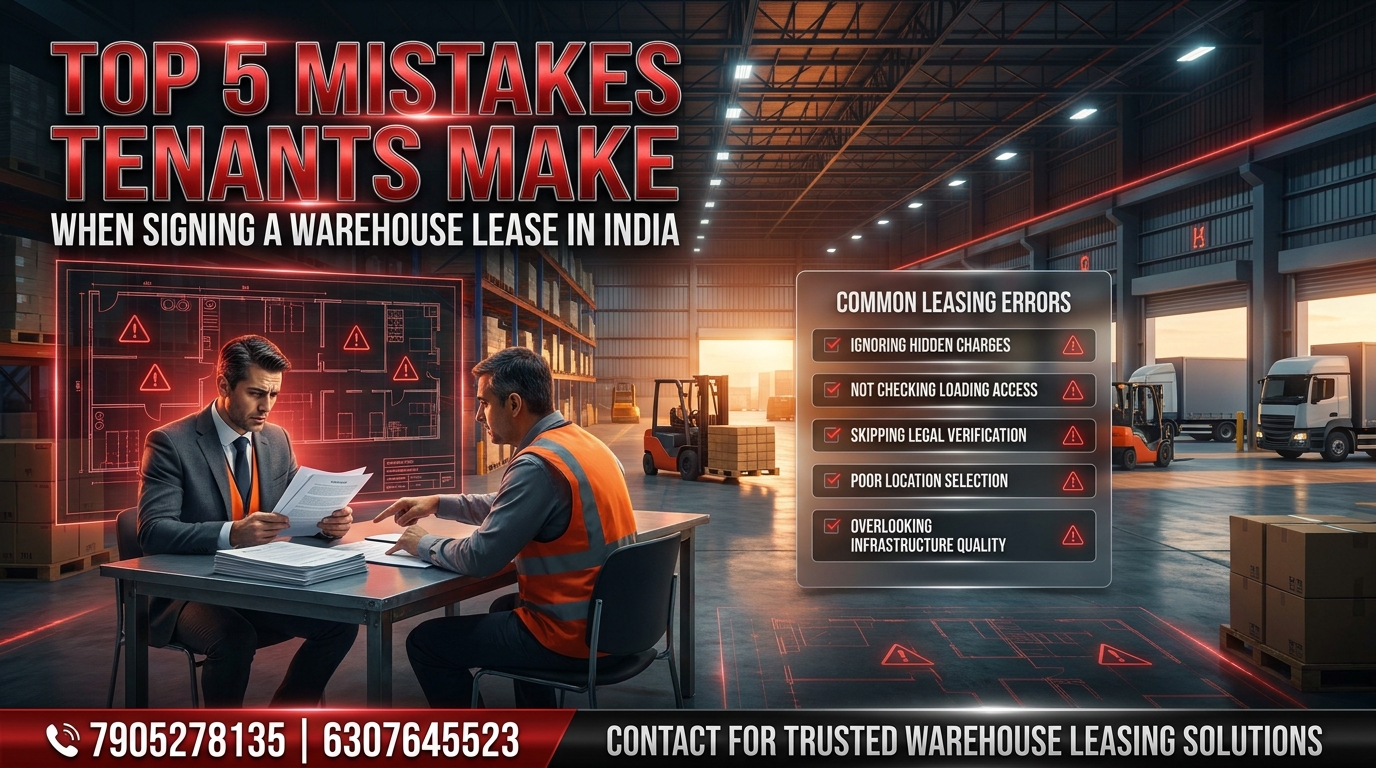
Signing a warehouse lease is one of the most important business decisions you will make in Lucknow. A good lease protects your business, keeps your costs predictable, and gives you the freedom to operate smoothly. A bad lease can trap you in a property that does not work for your operations, with costs that keep rising and terms that leave you with no way out.
The unfortunate truth is that most warehouse tenants in Lucknow make at least one or two of the same mistakes when signing a lease. Some of these mistakes cost a few lakh rupees. Others can derail a business entirely. This blog covers the top five mistakes in detail so you know exactly what to avoid.
Why Warehouse Lease Mistakes Are So Common in Lucknow
Lucknow has a large and growing warehousing market. New businesses are entering the city. Existing businesses are expanding. The demand for quality warehouse space is strong. In this environment, tenants often feel pressure to sign quickly before a good property is taken by someone else.
That pressure to move fast is exactly where mistakes happen. Tenants skip due diligence, accept one-sided lease terms, or fail to understand what they are agreeing to. The result is a multi-year commitment to a property or terms that create ongoing problems.
Knowing the common mistakes in advance gives you the awareness to slow down, ask the right questions, and sign a lease that truly serves your business.
Mistake 1 — Not Reading the Lease Agreement Properly
This is the most common and the most costly mistake. Many tenants in Lucknow sign warehouse lease agreements without reading them carefully. They rely on a verbal summary from the landlord or broker, nod through the document signing, and assume everything is standard.
It is never standard. Every lease agreement has specific clauses that can work for or against you. Here are the clauses that most tenants fail to read or understand:
The Escalation Clause
This clause defines how rent increases over the lease period. Many lease agreements in Lucknow allow the landlord to increase rent by 10 to 15 percent annually, or even more, after the initial period. If you do not read this and negotiate it down to a cap of 5 to 8 percent, you could be paying significantly more than you budgeted within two to three years.
The Maintenance Clause
Who is responsible for what repairs? Many lease agreements in Lucknow put the burden of all maintenance — including structural repairs — on the tenant. This is negotiable but only if you read it before signing. After signing, you have agreed to it.
The Exit Clause
What happens if you need to vacate before the lease ends? Many agreements require three to six months of notice and impose penalties for early exit. Some do not allow early exit at all. If your business changes and you need to move, a poorly negotiated exit clause can cost you lakhs.
The Use Clause
What are you allowed to store in the warehouse? Some leases restrict the type of goods you can keep. If your business later needs to store a different category of product, a restrictive use clause can become a serious problem.
The solution is simple — read the lease word by word. If you do not understand something, ask a lawyer to explain it. Never sign a document you have not fully understood.
Mistake 2 — Not Verifying Electrical Capacity Before Signing
This mistake is specific to warehouse tenants and it is extremely common in Lucknow. Many tenants look at the warehouse building, like what they see, and sign the lease without checking whether the electrical supply can actually support their operations.
A warehouse that looks perfect may have an inadequate electrical connection. If your business requires three-phase power with a 75 kVA or 100 kVA load, but the property only has a 30 kVA single-phase connection, you will face constant tripping, equipment damage, and operational disruption from day one.
What to check before signing:
- Ask for the DVVNL electricity connection document and check the sanctioned load in kVA or kW
- Confirm whether the connection is single-phase or three-phase
- Calculate your own load requirement by adding up all equipment you plan to run
- Add 20 to 25 percent as a safety buffer to your calculated load
- If the sanctioned load is insufficient, either ask the landlord to upgrade before you sign or walk away
Upgrading an electricity connection through DVVNL in Lucknow takes four to eight weeks and costs money. If you are counting on being operational within a week of signing, an electrical capacity mismatch will cost you significantly in lost time and revenue.
Mistake 3 — Ignoring Location-Related Operational Costs
Many tenants in Lucknow choose a warehouse based on rent per sq. ft. alone without thinking about the total operational cost of that location. This is a mistake that results in paying less in rent but much more in transportation and logistics costs every single month.
A warehouse inside the city at Rs. 22 per sq. ft. might seem more expensive than a highway warehouse at Rs. 18 per sq. ft. But if the city warehouse adds 45 minutes to every truck trip due to traffic congestion, the fuel and time cost adds up fast.
For a business receiving or dispatching 25 truck trips per month, 45 extra minutes per trip at current diesel rates can mean Rs. 30,000 to Rs. 60,000 in additional monthly transportation costs. Over a three-year lease, that is Rs. 10 to 20 lakh in avoidable expense — just because of the wrong location choice.
Before signing any warehouse lease in Lucknow, calculate the true monthly operating cost of that location including:
- Rent per month
- Average transportation cost per trip including fuel and driver time
- Number of trips per month
- Time lost due to traffic or poor road access
- Any penalty cost from delayed deliveries caused by location inefficiency
If You Are Still Looking — Here Is a Property That Gets the Basics Right
Before we get to mistakes four and five, this is a good point to mention a warehouse in Lucknow that avoids many of the common pitfalls tenants fall into. If you are currently evaluating options, Ashoka Warehousing on Sitapur Road NH-24 is worth a serious look.
They offer a 15,000 sq. ft. newly constructed warehouse at Rs. 18 per sq. ft. — ready to move in, on a national highway, with modern infrastructure and no broker commission. The property is newly built, which means the electrical infrastructure is properly rated, the building is structurally sound, and there are no legacy maintenance issues to inherit.
Ashoka Warehousing | 15,000 sq. ft. | Rs. 18/sq. ft. | NH-24 Sitapur Road Lucknow | New Build | Ready to Move In
The Sitapur Road NH-24 location directly addresses Mistake 3 — location cost. Your trucks travel on the highway rather than through the city. Faster trips, lower fuel cost per delivery, and better logistics efficiency every single working day. For businesses that distribute across northern UP and beyond, NH-24 is one of the most strategically valuable warehouse addresses in Lucknow.
Mistake 4 — Not Negotiating the Security Deposit Amount and Terms
In Lucknow’s warehouse rental market, landlords typically ask for two to six months of rent as a security deposit. For a 15,000 sq. ft. warehouse at Rs. 18 per sq. ft., a three-month deposit is Rs. 8.1 lakh and a six-month deposit is Rs. 16.2 lakh.
Many tenants accept whatever deposit the landlord asks without negotiation. This is a mistake for two reasons.
First, a large security deposit ties up working capital that your business could be using for inventory, payroll, or growth. Every lakh in the landlord’s hands as security is a lakh not working in your business.
Second, the terms around the security deposit are often poorly defined in the lease. Tenants fail to specify:
- The exact conditions under which the deposit can be withheld by the landlord
- The timeline for returning the deposit after vacating — 30 days, 60 days, or undefined
- Whether the deposit earns any interest over the lease period
- The process for resolving disputes about deposit deductions
When the lease ends, a landlord who has your Rs. 10 lakh deposit and a vague lease clause about ‘damage to property’ can make it very difficult to recover the full amount. Getting specific, clear, and time-bound deposit return terms in your lease agreement is not optional — it is essential.
Mistake 5 — Not Doing a Physical Property Inspection Before Signing
The fifth and final mistake is one that surprises people because it seems so obvious — but it happens regularly in Lucknow’s warehouse market. Tenants sign leases based on floor plans, photos, or a single quick visit without doing a thorough physical inspection of the property.
A proper physical inspection of a warehouse before signing should include:
Structural Inspection
Check the roof for leaks or water damage marks. Check the walls for cracks. Check the flooring for uneven surfaces, weak spots, or damage. For heavy racking systems, the floor load capacity is critical — ask for the rated capacity and verify it.
Loading and Access Inspection
Drive a truck to the property and check whether it can enter easily. Check the turning radius inside the compound. Check the height of the loading bay and whether it matches your vehicle types. A warehouse that looks perfect from inside but cannot be accessed easily by your trucks is operationally useless.
Drainage and Water Proofing
Lucknow receives significant rainfall during the monsoon. Check whether the warehouse has proper drainage. Look for signs of past flooding or water ingress. Goods damaged by water in a poorly drained warehouse have no recourse if the lease does not clearly define the landlord’s responsibility for waterproofing.
Security and Lighting
Check the perimeter fencing, gate security, and whether there is adequate lighting for night operations. If you operate 24 hours or handle high-value goods, this is non-negotiable.
Why Ashoka Warehousing Is the Best Choice for Your Business
Ashoka Warehousing on Sitapur Road NH-24 is designed to protect tenants from all five of the mistakes described in this blog. The lease terms are clear and professionally drafted. The electrical infrastructure is newly installed and properly rated. The NH-24 highway location eliminates location-based operational cost inefficiency. The security deposit terms are standard and transparent. And the property is newly constructed, which means the physical inspection will not uncover any hidden structural, drainage, or access problems. At Rs. 18 per sq. ft. for 15,000 sq. ft., this is a warehouse where the basics are genuinely in order from day one.
Famous Warehouse Locations in Lucknow
- Amausi Industrial Area — near Lucknow airport, established logistics and FMCG hub
- Chinhat Industrial Estate — large SME industrial zone, Lucknow’s oldest industrial cluster
- Transport Nagar — primary goods handling and transshipment hub of Lucknow
- Bakshi Ka Talab (BKT) — growing industrial zone on the northern outskirts
- Gomti Nagar Extension — newer commercial area, some logistics and storage spaces
- Sitapur Road NH-24 — fastest growing highway warehouse corridor, new builds, best connectivity
Frequently Asked Questions (FAQ)
What is the most important clause to check in a warehouse lease agreement in India?
The escalation clause, the exit clause, and the maintenance responsibility clause are the three most critical. The escalation clause defines how much rent can increase each year. The exit clause defines your options if you need to leave before the lease ends. The maintenance clause defines who pays for what repairs. Getting these three right protects you through the entire lease period.
How do I calculate the right electrical load for my warehouse in Lucknow?
List every piece of equipment you will run — lights, fans, forklifts, conveyor belts, HVAC, computers, charging stations, and machinery. Add up their rated power in kW. Then add 20 to 25 percent as a safety buffer. The total is your required minimum sanctioned load. Ask the DVVNL connection document from the landlord and confirm the sanctioned load meets or exceeds this figure.
Is it normal for a warehouse landlord in Lucknow to ask for six months security deposit?
Six months deposit is on the higher end but is not uncommon for larger warehouse properties. Three months is more standard and is negotiable. If the landlord is asking for six months, counter-offer three months and offer something in return — a longer lease commitment or earlier payment dates. Always get the deposit return terms clearly defined in the lease.