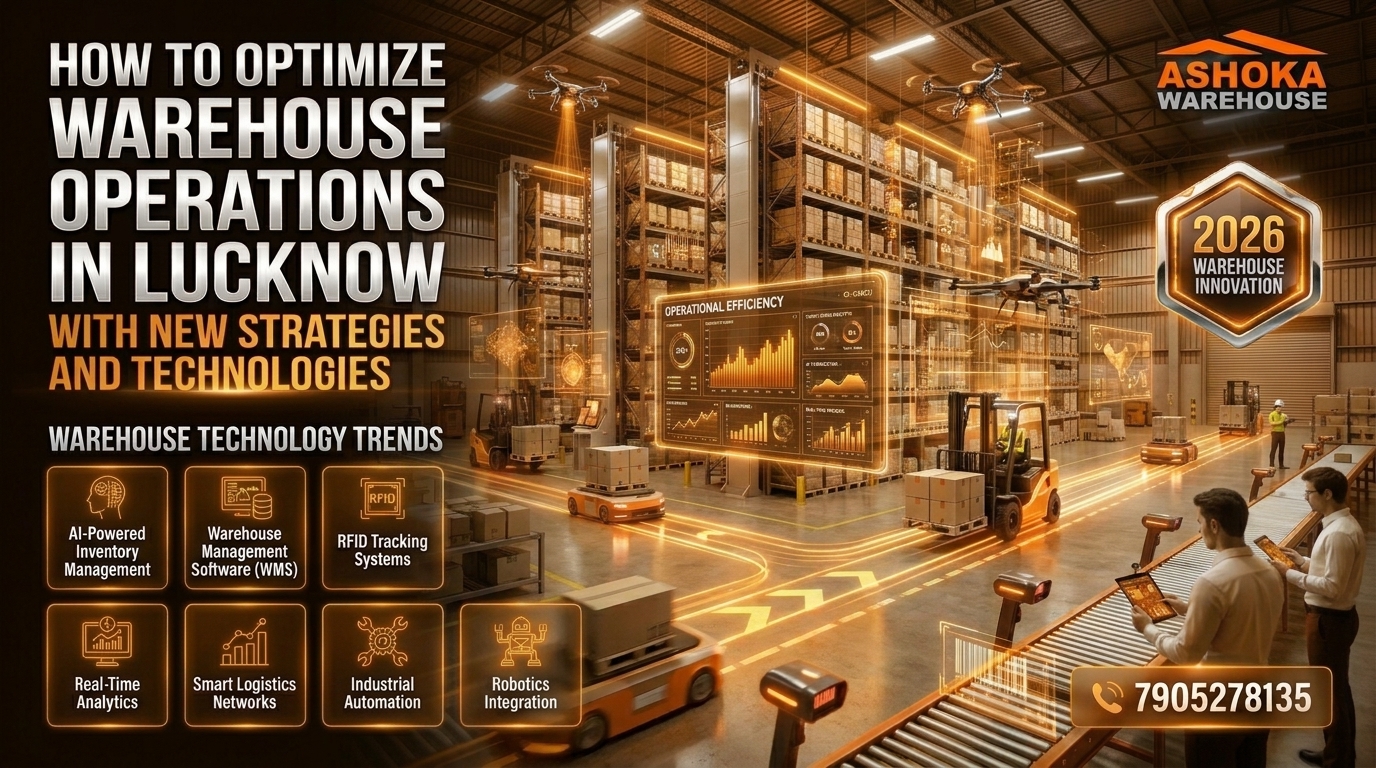
Warehouse efficiency is not a one-time fix. It is an ongoing combination of layout discipline, technology adoption, staff management, and — often underestimated — the physical building itself. A business operating from a poorly specified facility can implement every best practice available and still underperform a competitor working from a building designed for modern operations.
For business owners in Lucknow, 2026 presents a useful moment to revisit warehouse operations. The city’s warehouse supply has improved meaningfully, particularly on highway corridors like Sitapur Road near Bakshi Ka Talab, and the technologies that were considered enterprise-only two years ago are now accessible to mid-size operations. This article walks through the practical strategies and technologies that genuinely move the needle on warehouse efficiency, with specific reference to what a quality godown for rent in Lucknow on the NH-24 corridor can enable that older stock cannot.
Strategy 1 — Get the Layout Right Before You Get the Technology Right
The most common mistake in warehouse optimisation is investing in technology before fixing layout. A warehouse management system cannot compensate for a facility where storage zones, picking paths, and dispatch areas were never properly designed.
The ABC Zoning Principle
ABC analysis — categorising inventory by movement frequency — is one of the oldest warehouse principles and remains one of the most effective. Fast-moving SKUs (A items, typically 20 percent of SKUs generating 80 percent of movement) should sit closest to the dispatch area. Slow-moving items (C items) go to the back or upper racking levels.
For a business operating a 28000 sq.ft warehouse in Lucknow, proper ABC zoning alone can reduce picking time by 20 to 35 percent. This is a layout decision, not a technology purchase — but it requires floor space flexibility that older, cramped godowns often cannot provide.
Why Building Specification Matters for Layout
A 28000 sq.ft godown for rent in Lucknow with 24 to 28-foot ceilings allows three to four-tier racking, which means ABC zones can be designed both horizontally (near vs. far from dispatch) and vertically (eye-level for fast movers, higher levels for slow movers). A building with 14-foot ceilings limits this to a single dimension, reducing the effectiveness of any zoning strategy.
Strategy 2 — Warehouse Management Systems Are Now Affordable
As recently as 2022, a proper WMS implementation in India required significant capital investment — often Rs. 5 to 15 lakh for licensing plus hardware. In 2026, cloud-based WMS platforms are available on subscription models at Rs. 20,000 to 40,000 per month, covering inventory tracking, order management, and basic analytics.
For a business running a 28000 sq.ft warehouse for rent in Lucknow, this technology shift means real-time inventory visibility — previously a 3PL or enterprise feature — is now within reach for mid-size operations. The practical benefits: reduced stock-out incidents, faster cycle counts, and dispatch accuracy improvements of 15 to 25 percent in the first six months of implementation.
Barcode and RFID — Where Each Makes Sense
Barcode scanning remains the most cost-effective starting point for most Lucknow businesses — hardware costs Rs. 8,000 to 15,000 per scanner, and implementation does not require infrastructure changes. RFID, while more capable for high-volume operations, requires a higher upfront investment and is generally justified only above a certain throughput threshold — typically businesses dispatching 1,000+ units daily.
For a 28000 sq.ft warehouse on Sitapur Road in Lucknow handling a regional distribution operation, barcode-based WMS is usually the right starting point, with RFID as a future upgrade path once volumes justify it.
Strategy 3 — Optimize for Vehicle Movement, Not Just Internal Operations
Warehouse efficiency does not stop at the loading dock. The time a truck spends queuing, manoeuvring, and waiting for a dock slot is part of your operational cost — and it is heavily influenced by location.
The NH-24 Sitapur Road Advantage
A warehouse near NH24 Lucknow eliminates the city-traffic delays that plague inner-city industrial zones. For a business running 20 to 30 truck movements per month, the time saved per trip — typically 30 to 50 minutes versus a city-centre location — adds up to 15 to 25 hours of vehicle time saved monthly. At a conservative vehicle-hour cost of Rs. 500, that is Rs. 7,500 to 12,500 in monthly savings purely from location.
A 28000 sq.ft warehouse on Sitapur Road near Bakshi Ka Talab, with direct or near-direct NH-24 access, allows trucks to enter, load or unload, and exit without navigating congested city roads. This is a structural efficiency gain that no amount of internal process optimisation can replicate.
Strategy 4 — Right-Size for Current Operations, Design for Growth
One of the recurring inefficiencies in Lucknow’s warehouse market is mismatched sizing — either businesses cramped into spaces too small for proper zoning, or businesses paying for unused space in oversized facilities.
The 28,000 sq.ft category occupies a useful middle ground for many Lucknow businesses. At this size, a 28000 sq.ft godown for lease in Lucknow can support a fully zoned operation — bulk storage, forward-pick area, packing stations, receiving bay, and dispatch staging — with room for 20 to 30 percent growth before requiring relocation.
What 28,000 Sq.ft Supports
- Bulk storage zone (60% of area, approximately 16,800 sq.ft): 850 to 1,100 pallet positions at three-tier racking, 80% utilisation.
- Forward-pick / fast-mover zone: 2,500 to 3,500 sq.ft for high-turnover SKUs.
- Packing and dispatch area: 3,500 to 5,000 sq.ft supporting 10 to 18 packing stations.
- Receiving bay: 2,000 to 3,000 sq.ft for simultaneous multi-truck unloading.
- Office, welfare, and circulation: remaining 2,000 to 3,500 sq.ft.
A 28000 sq.ft warehouse for rent per sq.ft on the Sitapur Road corridor at Rs. 18 to 24 per sq.ft provides this configuration at a monthly rent of Rs. 5.04 to 6.72 lakh — a cost that, for a regional distributor or e-commerce fulfilment operation generating Rs. 50 lakh or more in monthly throughput, is a sustainable operational expense relative to the efficiency gains the right-sized space enables.
Strategy 5 — Energy and Sustainability as Operational Levers, Not Just Compliance
Energy cost is an underweighted line item in most warehouse operations. LED lighting retrofits reduce warehouse lighting costs by 40 to 60 percent compared to conventional fluorescent fixtures. Solar panel installations on warehouse roofs — increasingly viable on newer construction with appropriate roof load ratings — can offset 20 to 40 percent of a facility’s daytime power consumption.
For businesses evaluating a 28000 sq.ft warehouse in Lucknow on new-construction stock along the Sitapur Road corridor, these retrofits are significantly cheaper to implement than on older buildings with structural limitations. Beyond the direct cost saving, sustainability credentials are increasingly relevant for businesses supplying larger corporate clients or export markets, where ESG documentation is becoming part of vendor evaluation.
Strategy 6 — Staff Training and Retention as an Operational Strategy
Technology and layout improvements deliver their full value only when staff are trained to use them. A WMS implementation without proper training typically delivers 30 to 40 percent of its potential efficiency gain in the first year — the rest is lost to workarounds, manual overrides, and inconsistent data entry.
Staff retention is also a location factor. A 28000 sq.ft godown for rent in Lucknow on the Sitapur Road corridor near Bakshi Ka Talab benefits from the area’s improving residential development, which is gradually building a local labour pool. Warehouses that are easy for staff to reach — by bus, auto, or two-wheeler — see lower turnover, which directly protects the investment made in training.
Bringing It Together — The Optimization Checklist
- Conduct an ABC analysis of your inventory and redesign storage zones accordingly.
- Implement a cloud-based WMS with barcode scanning as the baseline technology layer.
- Evaluate your warehouse location for vehicle movement efficiency — highway access near NH-24 reduces transport cost structurally.
- Right-size your facility — a 28000 sq.ft warehouse for rent in Lucknow suits operations with Rs. 50 lakh+ monthly throughput and room to grow.
- Retrofit lighting to LED and evaluate solar feasibility, especially on newer construction.
- Invest in staff training alongside any technology rollout, and prioritise locations with good staff accessibility.
Frequently Asked Questions (FAQ)
What is the first step for a small business in Lucknow looking to optimize warehouse operations?
Start with an inventory audit and ABC analysis — this requires no capital investment and typically reveals the highest-impact, lowest-cost improvements. If you are searching ‘warehouse near me for rent’ because your current space limits your ability to implement proper zoning, that is often the underlying signal that a layout-driven move, not just a process change, is needed.
How much does it cost to implement a basic WMS for a 28,000 sq.ft warehouse in Lucknow?
A cloud-based WMS with barcode scanning for a 28000 sq.ft warehouse in Lucknow typically costs Rs. 25,000 to 40,000 per month in subscription fees, plus a one-time hardware investment of Rs. 80,000 to 1.5 lakh for scanners, printers, and basic networking. This is a fraction of the Rs. 5 to 15 lakh upfront cost that on-premise WMS systems required just a few years ago.
Why does the Sitapur Road location near Bakshi Ka Talab matter for operational optimisation specifically?
Because two of the six strategies in this article — vehicle movement efficiency and right-sizing for growth — are directly enabled by the building and location, not just internal processes. A 28000 sq.ft warehouse on Sitapur Road in Lucknow with NH-24 access and modern ceiling heights gives you the physical platform that layout and technology strategies need to deliver their full impact. The same WMS implemented in a 14-foot ceiling city-zone godown will deliver less value than in a properly specified highway-corridor facility.