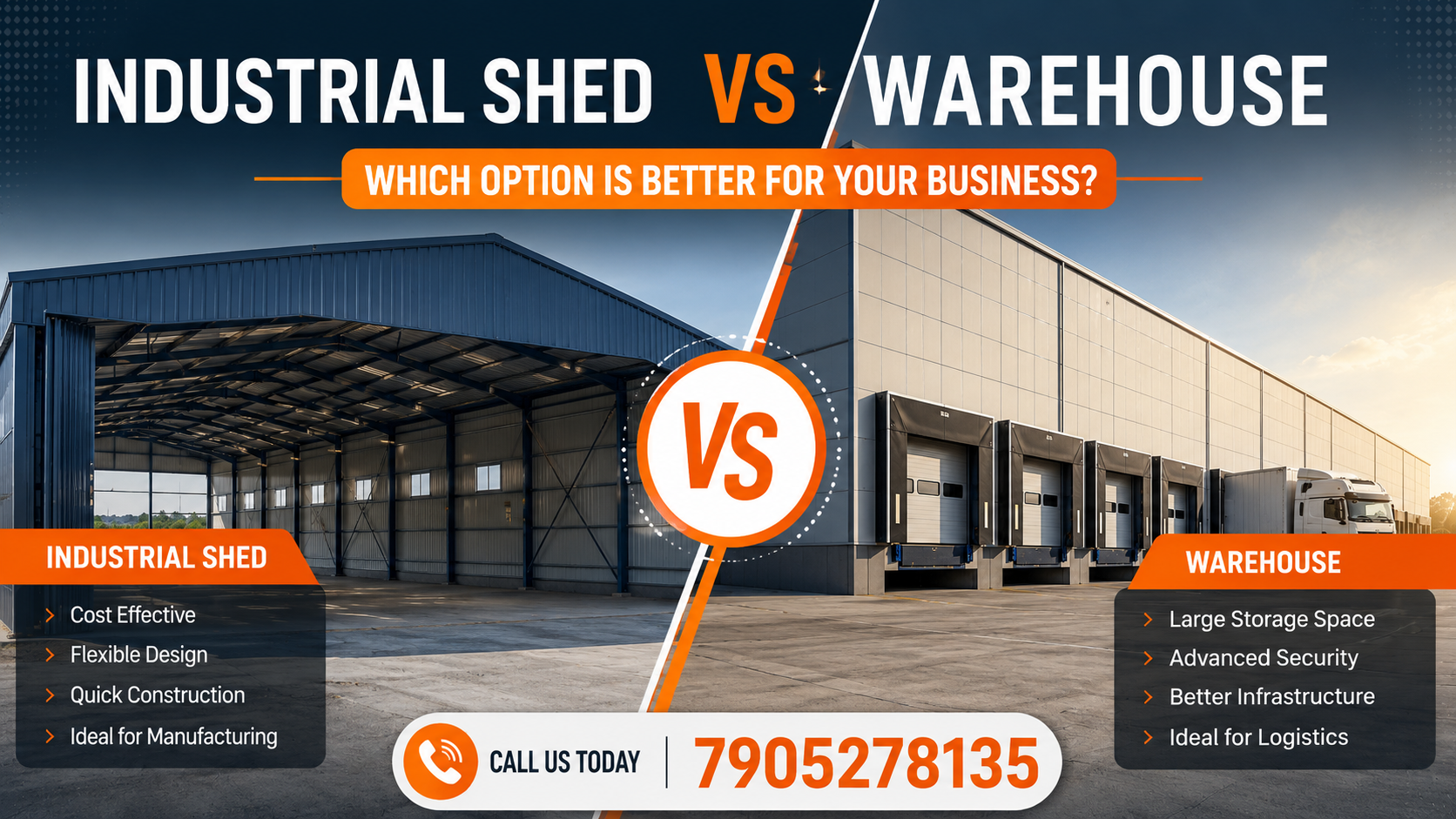
The terms get used interchangeably, the listings blur the boundaries, and business owners end up evaluating properties without a clear framework for deciding which type of space actually fits what they need. For a business currently considering a 6500 sq ft warehouse for rent in Lucknow, developing a clearer understanding of what distinguishes industrial sheds from warehouses — and which fits which operational model — makes the property search considerably more productive.
Why the Confusion Exists and Why It Matters
In Lucknow’s commercial property market, particularly in developing corridors like Bakshi Ka Talab along Sitapur Road, many properties have been built without rigid adherence to a single-use classification. A developer building a 6500 sqft industrial shed rent Lucknow structure may design it for general commercial use, and it ends up being described as either a shed or a warehouse based on whoever is marketing it at any given point.
This means that the label alone — shed or warehouse — doesn’t reliably predict what you’ll find inside. What matters is the set of specific characteristics the building has, and whether those characteristics align with what the business actually needs. Two businesses looking at the same 6500 sq ft warehouse lease might find it ideal for one’s operations and problematic for the other’s, based entirely on the specifics of what each business does.
What Distinguishes Each Type in Practice
Industrial Sheds: Designed for Activity, Not Just Storage
A properly designed industrial shed prioritises floor-level operations: heavy-duty flooring for machinery, robust structural framing to support overhead cranes or mezzanine loads in manufacturing contexts, and power infrastructure designed for production equipment. Ventilation, lighting, and access are configured around the assumption that workers and machines are doing something inside, rather than primarily moving goods through.
For a business in light manufacturing, assembly, or processing in Lucknow, these features matter directly. A small food processor or garment unit evaluating a 6500 sqft warehouse rental Lucknow would find an industrial shed’s floor and power characteristics more aligned with their needs than a warehouse’s racking-optimised specifications.
Warehouses: Designed for Efficient Goods Movement
A purpose-built warehouse optimises for inventory throughput — the speed and accuracy with which goods move from inbound delivery through storage to outbound dispatch. This drives design choices that differ from industrial sheds: higher ceilings to maximise vertical storage through racking, dock-height loading to reduce manual handling during delivery and dispatch, and internal layouts that minimise cross-traffic between different operational zones.
For a small size warehouse for rent in Lucknow intended as a regional DC Lucknow node, a 3PL large format provider’s local depot, or an e-commerce mega warehouse for a mid-sized online seller, these design features directly affect how efficiently the operation runs — and a building without them forces operational workarounds that add time and cost to every working day.
Business Models and Their Space Requirements
The E-Commerce Seller
E-commerce fulfilment is one of the clearest use cases where a warehouse rather than an industrial shed is the right choice. The picking, packing, and dispatch workflow requires organised, accessible inventory storage — typically multi-tier racking — combined with reliable courier pickup access and WMS integration for a smart warehouse Lucknow setup. The height and floor specifications of a purpose-built warehouse support this; a typical industrial shed often doesn’t without modification.
The Regional Distributor
A regional distributor using a 6500 sq ft warehouse UP or large godown 6500 sqft Lucknow as a stock holding and onward distribution point needs reliable loading access, enough floor space for stock organisation by product category, and adequate security and inventory management infrastructure. Warehouse design serves this use case well; industrial sheds can work with some adaptation, but the loading access consideration is often the limiting factor.
The Light Manufacturer
A light manufacturer using the space primarily for production needs the floor and power characteristics of an industrial shed rather than the racking height and dock access of a warehouse. For this business model, the shed classification is not just a label — it reflects genuinely different structural choices that affect daily operational viability.
Evaluating the Bakshi Ka Talab Options
The Bakshi Ka Talab area presents a useful mix for businesses comparing these options. The corridor’s development over the past several years has produced both industrial sheds and warehouse-type properties in the small-to-medium format range, including at around 6500 sq ft. This means a business can genuinely compare both options in the same geographic area rather than having to evaluate different parts of the city for each property type.
The ring road connectivity that makes BKT practical for high-volume storage UP and centralized distribution warehouse operations is equally relevant for light industrial businesses with supply chain links to other UP districts, making the area’s advantages broadly applicable across both property categories.
A Simple Decision Rule
For most businesses, the shed vs. warehouse decision can be simplified to one question: is your primary operational activity production-oriented or distribution-oriented? If production — shed. If distribution — warehouse. If genuinely both — evaluate hybrid properties against the more demanding requirements of each activity to find the most suitable compromise.
This rule has exceptions, and the specific building specifications always matter more than the general category, but as a starting framework it resolves the choice clearly for the majority of businesses evaluating a 6500 sq ft warehouse for rent in Lucknow.
Frequently Asked Questions
1. What is the most important specification to check when evaluating a 6500 sq ft property in Lucknow for warehousing?
Eave height is consistently the specification that most affects the suitability of a property for warehousing versus industrial use. A building with insufficient height for the planned racking configuration cannot be cost-effectively modified, while other specifications — flooring, power, dock access — are generally more amenable to upgrade or adaptation if needed.
2. Does a multi-brand storage facility in Lucknow need a warehouse or can it operate from an industrial shed?
A multi-brand storage facility needs the inventory management features of a warehouse — racking for organised stock separation by brand, adequate height, and loading access for multiple clients’ inbound and outbound schedules. An industrial shed can sometimes serve this need if it has adequate height and floor quality, but the absence of dock-height loading and the lower eave heights typical of sheds create operational limitations that a purpose-built warehouse avoids.
3. How should a business evaluate a listing that calls itself a warehouse but may actually be an industrial shed?
Request specific specification data rather than relying on the category label: eave height at the wall (not ridge height), floor load rating with documentation, dock configuration and height, electrical sanctioned load, and land use classification. These specifics tell the real story about what the property supports, regardless of how it is labelled in the listing.
Final Note
The shed vs. warehouse decision ultimately comes down to what the business actually does and what specifications support those activities most efficiently. Both options are available in Lucknow’s Bakshi Ka Talab corridor in the 6500 sq ft range. If you’d like to discuss specific properties against your operational requirements, feel free to reach out.