India’s E-Commerce Boom Has Made Warehousing a Competitive Advantage
In 2026, India’s e-commerce sector is projected to cross ₹6.5 lakh crore in GMV. Every order needs to be picked, packed, and shipped from somewhere — and that somewhere is your warehouse. Whether you’re selling on Amazon and Flipkart, running your own D2C brand on Shopify, or supplying to Blinkit and Swiggy Instamart, your warehousing infrastructure is one of the most direct levers on your unit economics.
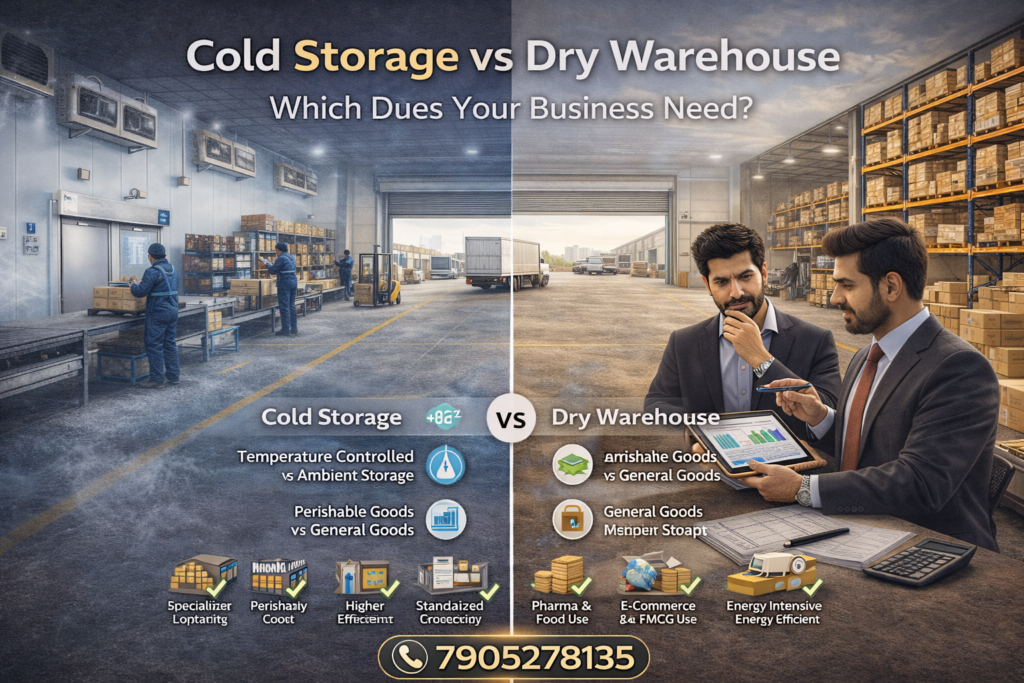
The storage decision — cold vs ambient — determines your entire operational model. Get it wrong and you’re either paying for expensive refrigerated infrastructure you don’t need, or losing product to spoilage and quality complaints because you didn’t invest in the right temperature control.
The Indian E-Commerce Seller’s Storage Decision Framework
- Category 1 — Pure Dry: Electronics, mobile accessories, clothing, footwear, books, toys, home decor, hardware, auto accessories. 100% ambient dry warehouse. No exceptions.
- Category 2 — Dry Climate-Controlled: Chocolates, premium snacks, health supplements/nutraceuticals, coffee, tea, cosmetics/skincare. Standard dry warehouse with dehumidification and temperature monitoring (18°C–25°C).
- Category 3 — Refrigerated Cold Storage: Fresh food, dairy, fresh juices, certain probiotics, fresh-cut flowers, some functional beverages. Full refrigerated cold store required (+2°C to +8°C).
- Category 4 — Frozen Storage: Frozen meals, ice cream, frozen seafood/meat, frozen desserts. Full frozen storage required (−18°C to −20°C).
- Category 5 — Mixed: FMCG brands with both ambient and cold-chain SKUs (e.g., a health food brand selling both granola bars (ambient) and probiotic drinks (cold)). Requires either separate facilities or a multi-temperature Grade A warehouse.
Quick Commerce Dark Stores — The Cold Storage Question
Quick commerce platforms (Blinkit, Swiggy Instamart, Zepto, BigBasket BB Now) have fundamentally changed urban grocery delivery. Their dark stores — typically 2,000–5,000 sq ft in residential neighbourhoods — carry everything from ambient packaged goods to fresh dairy and frozen snacks under one roof.
This means dark store operators must manage multiple storage zones within a small space: ambient shelving for packaged goods (60–70% of SKUs), a reach-in refrigerator bank for dairy and fresh produce (20–25% of SKUs), and a small freezer section for ice cream and frozen items (5–10% of SKUs). The infrastructure investment for a compliant dark store with all three zones is ₹15–₹35 lakhs — a significant upfront cost for small operators.
The D2C Brand’s Storage Progression Model
- Use a 3PL partner (Shiprocket Fulfil, Pickrr, Vamaship). Don’t rent your own warehouse yet. Focus on product and marketing.Stage 1 — 0 to 500 orders/month:
- Evaluate 3PL vs. shared warehouse space. If margins support it and you need more control, consider a small dedicated space (500–1,500 sq ft).Stage 2 — 500 to 3,000 orders/month:
- Dedicated warehouse lease makes economic sense. Choose location based on your top delivery pincode clusters.Stage 3 — 3,000 to 10,000 orders/month:
- Multi-city fulfilment strategy. Consider hub-and-spoke model with a primary warehouse and satellite forward stores or 3PL partnerships in secondary cities.Stage 4 — 10,000+ orders/month:
Lucknow as a D2C Fulfilment Hub for Central & Eastern India
Lucknow is increasingly being recognised as a strategic D2C fulfilment hub for brands targeting the central and eastern India market. With excellent rail connectivity to Delhi, Varanasi, Patna, and Kolkata, and direct highway access to UP’s 75 districts, a warehouse in Lucknow can service 50+ million potential customers within 24-hour delivery time.
ASHOKA WAREHOUSING — LUCKNOW Premium Dry Warehouse / Godown Available for Rent Location: Sitapur Road, NH-24 National Highway — just 20 minutes from Lucknow Junction Rent: ₹18 per sq. ft. — Highly Competitive Market Rate Ideal For: Manufacturers · Importers · Exporters · Wholesalers · Transport Companies · Logistics & Distribution Businesses Highway Access: Direct NH-24 frontage — seamless connectivity to Delhi NCR, Kanpur, Gorakhpur, and all major UP trade corridors |
For D2C brands and e-commerce sellers dealing in ambient products — packaged foods, personal care, health & wellness, fashion accessories, consumer electronics — Ashoka Warehousing on NH-24, Sitapur Road at ₹18/sq ft is ideally positioned for central India fulfilment. The 20-minute proximity to Lucknow Junction enables seamless rail dispatch for east India shipments, while direct NH-24 access ensures fast courier partner pickups for marketplace orders.
FAQs for E-Commerce Sellers
Q: Should I invest in my own cold storage or use a 3PL cold chain partner for my food D2C brand?
For food D2C brands doing under 2,000 cold-chain orders per month, a 3PL cold chain partner is almost always the right answer. Companies like Mahindra Logistics, Delhivery, Coldman Logistics, and Snowman Logistics (India’s largest cold chain 3PL) offer shared refrigerated storage at flexible per-pallet or per-sq-ft rates. Setting up your own cold store requires ₹50 lakhs–₹2 crore in capital, a 3–5 year lease commitment, and specialised operations management — not practical for a growing brand that needs capital for product and marketing. Graduate to your own cold chain infrastructure only when monthly cold storage costs to your 3PL exceed ₹3–₹5 lakhs consistently.
Q: What is the minimum order quantity to make a dedicated warehouse lease financially viable for an e-commerce seller?
The break-even analysis depends on your product category, average order value, and current 3PL costs — but as a general benchmark, a dedicated warehouse lease typically becomes financially viable when you’re consistently processing 3,000–5,000 orders per month for standard D2C products. At this volume, the cost of your own warehouse (rent, staff, utilities) is typically lower than 3PL fulfillment fees, and the operational benefits (faster processing, better quality control, custom packaging capability) create tangible business value. Run a 3-month comparison of your actual 3PL costs vs. projected own-warehouse costs before committing to a lease.