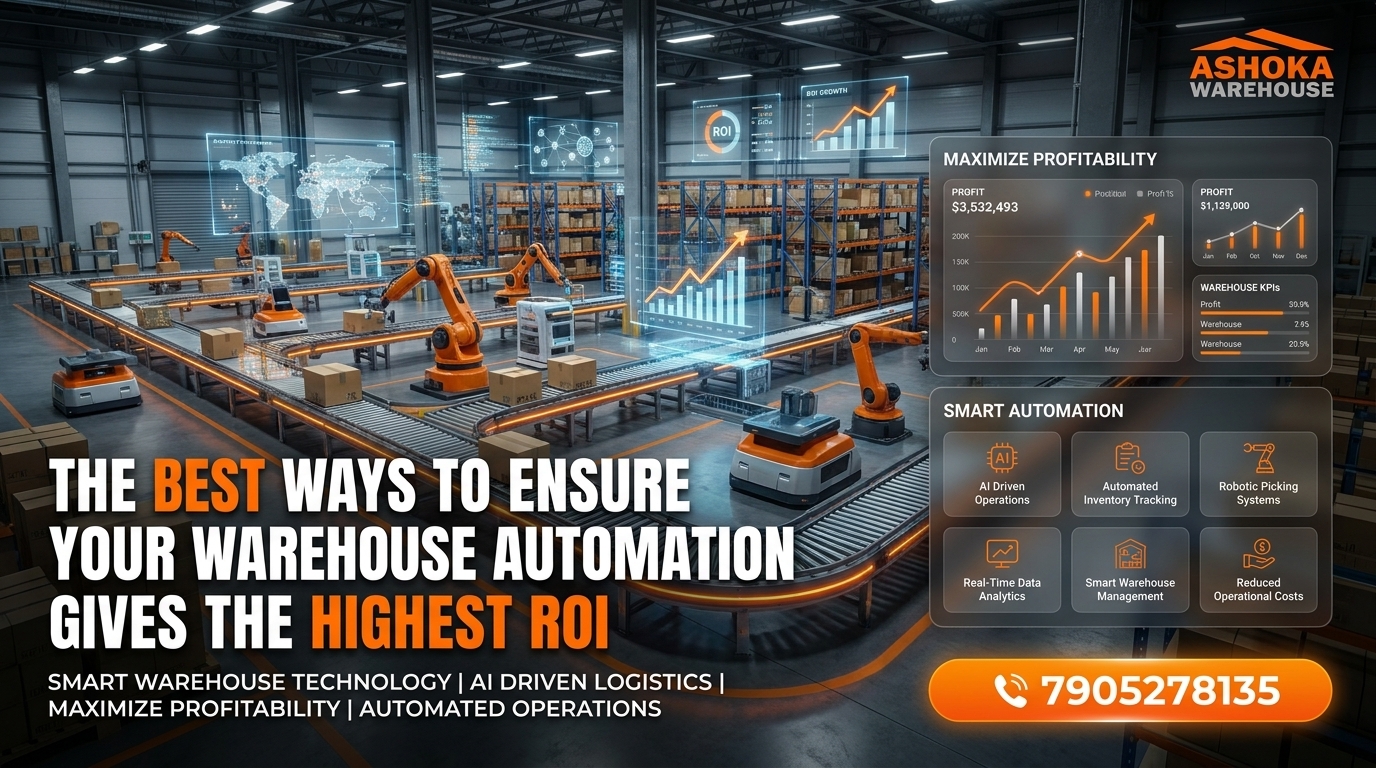
Warehouse automation has moved from a concept discussed in logistics conferences to a practical reality for businesses of almost every size. Yet many companies invest in automation tools and systems without first asking a foundational question: does the physical space I’m operating from support the kind of automation I’m deploying? For business owners searching for a godown for rent in Lucknow, this connection between technology and physical infrastructure matters more than it might initially appear.
Why Automation ROI Starts With the Right Building
Return on investment from warehouse automation doesn’t happen in isolation. Automated picking systems, conveyor setups, barcode-driven inventory tracking, and pallet management solutions all function best in spaces built — or at minimum, adapted — to accommodate them. A building with low ceilings, uneven floors, or cramped loading access can cancel out much of the efficiency gain that automation is supposed to deliver.
This is one reason why businesses evaluating a 28000 Sq.ft warehouse for rent in Lucknow increasingly look at physical specifications alongside lease terms. The floor load-bearing capacity, available height for racking systems, electrical load for automated equipment, and the width of internal aisles all directly affect how well automation performs once installed.
Automation Tiers: Matching Technology to Business Scale
Not all automation requires a massive capital outlay. Industry practitioners often categorise warehouse automation across three broad tiers, each with different implications for space requirements.
Tier 1 — Basic Digitisation
This covers barcode scanning, warehouse management software (WMS), and digital inventory records. Almost any godown can support this level, including smaller units. However, even at this stage, having a reliable power supply and basic IT infrastructure matters — points worth confirming when evaluating any 28000 Sqft godown for rent in Lucknow.
Tier 2 — Semi-Automated Systems
Conveyor belts, automated sorting, and pick-to-light systems fall here. These require adequate ceiling height, level flooring, and a layout that supports linear or zonal workflow design. A 28000 Sq.ft space planned with operational flow in mind — rather than a legacy building adapted from another use — tends to support this tier far better.
Tier 3 — Fully Automated or Robotic
Autonomous mobile robots (AMRs), automated storage and retrieval systems (AS/RS), and goods-to-person systems require clear-span interiors, reinforced flooring, and careful electrical planning. At this tier, the physical building is as important an investment as the technology itself.
The Sitapur Road Advantage for Automation-Ready Warehouses
One reason the Sitapur Road corridor in Lucknow has attracted attention from logistics and distribution businesses is the prevalence of newer construction along this stretch. Many warehouses here were built within the last five to seven years, which means they often feature specifications that older buildings in the city’s interior simply don’t offer — higher eave heights, RCC flooring, and wider internal spans without support columns.
A 28000 Sq.ft warehouse on Sitapur Road in Lucknow is therefore more likely to be automation-compatible without significant additional investment compared to a similarly sized older building elsewhere in the city. For businesses planning a phased automation rollout, starting in a space that won’t require structural modification later can meaningfully reduce the total cost of that journey.
Bakshi Ka Talab: Practical Value for Growing Businesses
Bakshi Ka Talab, situated along this same northwestern corridor, has become a practical option for businesses that need medium-to-large format space without the higher costs that come with more established industrial zones. For a business deploying Tier 1 or early Tier 2 automation, a 28000 Sq.ft warehouse in Lucknow in this area can offer good value — particularly if the business’s automation strategy is still evolving and flexibility in lease terms is a priority.
The area’s connectivity to the outer ring road also matters here. Automated warehouses often handle higher throughput than manual operations, which increases the frequency and volume of inbound and outbound truck movements. Road access that can comfortably accommodate this increased movement is a practical consideration, not a secondary one.
Calculating ROI: What Actually Drives the Numbers
When businesses evaluate automation ROI, the headline metrics typically include reductions in labour cost, improvements in order accuracy, faster fulfilment times, and reduced losses from damage or misplaced stock. However, two factors that are often underweighted are occupancy cost and space utilisation.
A well-specified 28000 Sq.ft warehouse for rent per sqft that enables vertical racking and efficient horizontal flow can generate higher throughput per square foot than a larger, poorly configured space. In this sense, the lease rate is only one variable — what a business does with the space per square foot it pays for is equally important to the overall ROI calculation.
What to Check Before Committing to a Space for Automation
- Floor flatness and load rating: Critical for robotic systems and heavy racking
- Eave height: A minimum of 9–10 metres is generally needed for multi-tier AS/RS
- Column spacing: Wider bays allow more flexible racking configuration
- Electrical capacity: Three-phase supply with adequate sanctioned load
- Dock height: Consistent dock heights simplify automated loading/unloading integration
- Internet and data connectivity: Often overlooked, but essential for WMS and IoT-based systems
When searching for a ‘warehouse near me for rent’ online, businesses often filter first by size and location. Adding a checklist like this to the evaluation process — even informally, during a site visit — can save significant cost and disruption later.
Frequently Asked Questions
1. Does a 28000 sq.ft warehouse in Lucknow offer enough space for meaningful automation?
Yes, for most mid-sized distribution or manufacturing businesses. This size comfortably supports Tier 1 and Tier 2 automation, with room for phased Tier 3 deployment depending on the product category and throughput volume. The key is that the building’s specifications — not just its square footage — align with the automation systems planned.
2. How does the Sitapur Road corridor compare to other areas in Lucknow for automation-ready warehouses?
The newer construction prevalent along Sitapur Road and in the Bakshi Ka Talab area tends to offer better baseline specifications — height, flooring, electrical capacity — than older industrial pockets. This makes it a more practical starting point for businesses with automation plans, even if those plans are still in early stages.
3. Should a business finalise its automation plan before selecting a warehouse, or vice versa?
Ideally, both should be considered together. The physical constraints of a building directly affect which automation systems are feasible, while the automation roadmap informs which building specifications are non-negotiable. Separating the two decisions can result in a space that limits what the technology can actually deliver.
Closing Thoughts
Warehouse automation and the right physical space are not separate decisions — they are two sides of the same investment. For businesses in Lucknow planning to improve warehouse efficiency through technology, the choice of a godown for lease in Lucknow is as strategically important as the automation system itself. If you’re evaluating a 28000 Sq.ft warehouse for rent in this corridor and want to talk through how a specific property aligns with your operational plans, feel free to reach out — we’re happy to help you think it through.