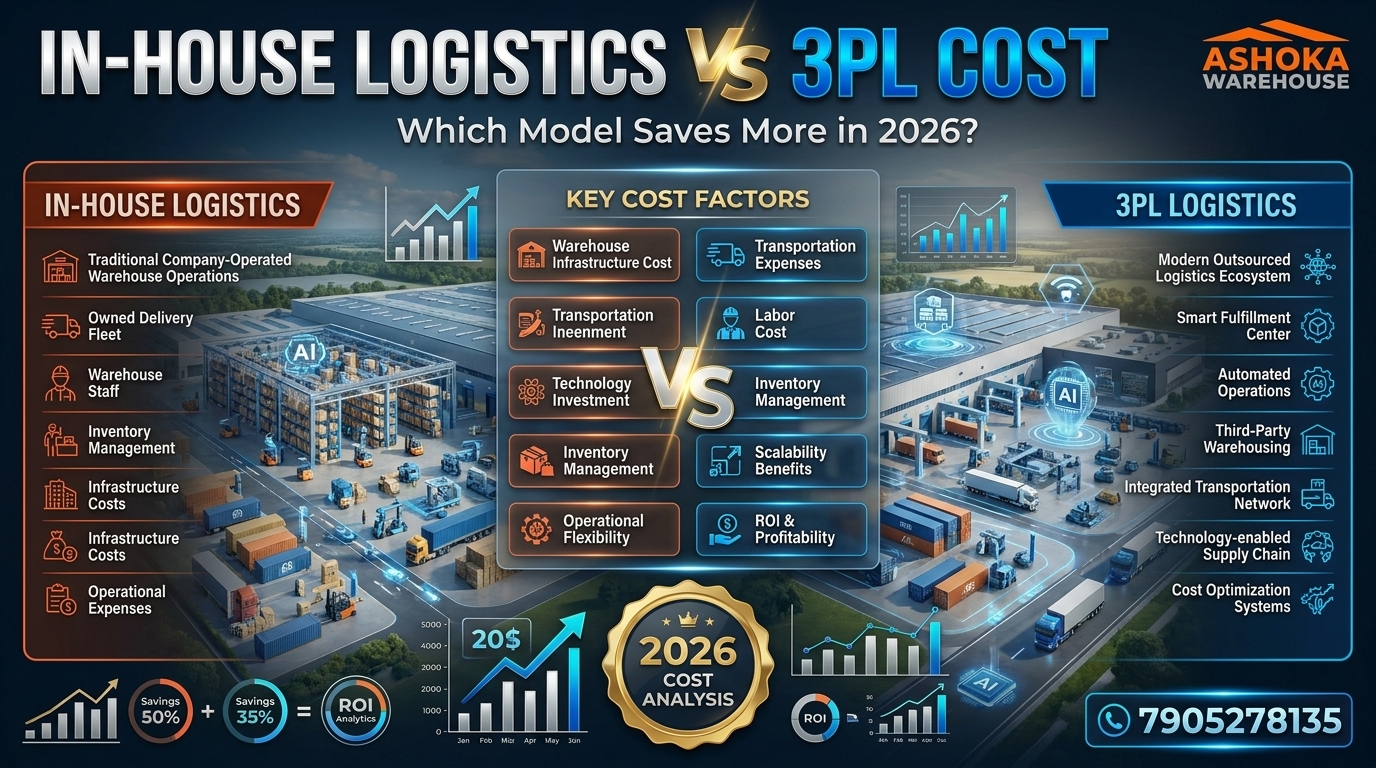
Every growing business in India eventually faces the same question: should we manage our own warehousing and logistics, or hand it to a third-party provider? In 2026, with logistics costs rising, e-commerce timelines tightening, and warehouse supply in cities like Lucknow finally maturing, this question has a more nuanced answer than it did even three years ago.
The in-house vs 3PL debate is not new. But the context has changed. Fuel costs, labour availability, GST compliance requirements, and the availability of quality godown for rent in Lucknow at competitive rates have all shifted the calculation in ways that are worth examining carefully — whether you are running a small distribution operation or managing a regional supply chain.
This article breaks down the real costs on both sides, identifies which business types benefit more from each model, and looks at why the right warehouse location — particularly on Lucknow’s NH-24 corridor near Bakshi Ka Talab — can change the economics of the in-house model significantly.
What In-House Logistics Actually Costs
The most common mistake businesses make when evaluating in-house logistics is calculating only the visible costs. Rent, staff salaries, and fuel are easy to quantify. The hidden costs are what most P&Ls undercount.
The Direct Cost Stack
For a business running a mid-size in-house warehousing operation in Lucknow — say a 22,000 sq.ft warehouse in Lucknow for a regional FMCG or pharma distributor — the direct monthly cost structure typically looks like this:
- Warehouse rent: At Rs. 18 to 24 per sq.ft for a 22000 sq.ft godown for lease in Lucknow on a highway corridor, monthly rent runs Rs. 3.96 to 5.28 lakh.
- Staff costs: A 22,000 sq.ft operation with a supervisor, 8 to 12 warehouse workers, and a security team runs Rs. 1.8 to 2.8 lakh per month in salaries and compliance costs.
- Utilities: Three-phase power, water, and basic facility maintenance — Rs. 40,000 to 80,000 monthly depending on equipment load.
- Transport fleet: For businesses with owned vehicles, depreciation, fuel, driver salaries, insurance, and maintenance add Rs. 1.5 to 3 lakh per month for a small fleet.
- Technology and systems: WMS, barcode scanners, and basic inventory software — Rs. 20,000 to 40,000 per month amortised over implementation cost.
Total direct monthly cost for an in-house 22,000 sq.ft warehouse for rent per sq.ft operation in Lucknow: approximately Rs. 8 to 12 lakh per month, before accounting for seasonality and capital employed.
The Hidden Cost Stack
Beyond direct costs, in-house logistics carries a set of hidden expenses that rarely appear in monthly P&L reviews but accumulate significantly over a year:
- Management time: A warehouse operation in Lucknow requires consistent senior management attention — vendor disputes, staff issues, compliance, and operational troubleshooting. Estimated value: Rs. 50,000 to 1.5 lakh per month in management time diverted from core business.
- Capital lock-in: Security deposits for a 22,000 sq.ft godown for rent in Lucknow at 3 to 6 months’ rent means Rs. 12 to 31 lakh locked in non-productive capital.
- Compliance risk: Fire NOC maintenance, labour law compliance, and GST documentation for an in-house facility create ongoing administrative cost and periodic risk exposure.
- Peak-to-average gap: In-house warehouses are sized for peak. In off-peak periods, you pay for space and staff that are underutilised.
What 3PL Actually Costs
Third-party logistics pricing in India is typically structured around three components: storage cost per pallet or cubic metre per month, handling charges per inbound and outbound movement, and fulfilment fees per order dispatched. For a business moving equivalent volumes through a 3PL versus an in-house 22000 sq.ft warehouse in Lucknow, the monthly 3PL cost typically runs:
- Storage: Rs. 180 to 350 per pallet position per month, depending on the 3PL and location.
- Handling (in + out): Rs. 25 to 60 per pallet movement.
- Fulfilment: Rs. 12 to 30 per order dispatched, for e-commerce businesses.
- Value-added services: Packing, labelling, kitting — priced per unit.
For a mid-size business holding 400 to 600 active pallet positions and dispatching 200 to 300 orders daily, a 3PL arrangement in Lucknow typically runs Rs. 7 to 13 lakh per month — comparable to the in-house cost but with a very different risk profile and flexibility structure.
Where 3PL Has a Cost Advantage
3PL wins on flexibility and capital efficiency. There is no security deposit, no lease commitment, and costs scale with volumes. In seasonal businesses — FMCG, apparel, agricultural inputs — where volumes swing 2x to 3x between peak and off-peak, 3PL can be 25 to 40 percent cheaper on a total annualised cost basis because you only pay for what you use.
Where In-House Has a Cost Advantage
In-house wins on control and per-unit cost at scale. A business running consistently high volumes — above 85 percent utilisation of a 22000 sq.ft warehouse in Lucknow year-round — will typically find in-house cheaper by Rs. 1.5 to 3 lakh per month compared to equivalent 3PL pricing. At that utilisation level, the fixed cost advantage of in-house outweighs the flexibility premium of 3PL.
The Location Variable — Why Bakshi Ka Talab Changes the In-House Calculation
For businesses leaning toward in-house warehousing in Lucknow, location quality is the variable that most directly affects the total cost comparison. A 22000 sq.ft warehouse on Sitapur Road in the Bakshi Ka Talab corridor near NH-24 changes the in-house calculation in several meaningful ways.
Lower Transport Cost Within the Model
A warehouse near NH24 Lucknow eliminates city-traffic delay from every inbound and outbound vehicle movement. For a business making 60 to 80 truck movements per month, the time saving versus a city-centre location translates to Rs. 1.5 to 3 lakh per month in reduced vehicle-hour cost. This saving makes in-house economics more competitive against 3PL alternatives that are typically located in suburban or highway zones by default.
Better Infrastructure at Competitive Rent
The 22000 sq.ft warehouse for rent in Lucknow available on the Sitapur Road corridor near Bakshi Ka Talab offers modern construction — ceiling heights of 22 to 28 feet, engineered flooring, three-phase power — at Rs. 18 to 24 per sq.ft. This is the 22000 sq.ft warehouse rent per sq.ft rate that makes in-house warehousing economically viable without paying the premium of established zones like Amausi.
For context: equivalent specification in the Amausi area runs Rs. 28 to 40 per sq.ft. The Sitapur Road differential of Rs. 6 to 16 per sq.ft on 22,000 sq.ft saves Rs. 1.32 to 3.52 lakh per month in rent alone — a saving that can swing the in-house vs 3PL calculation significantly in favour of in-house.
The Packing and Dispatch Advantage
A 22,000 sq.ft industrial warehouse Sitapur Road property gives a packing and dispatch warehouse operation dedicated space to design proper zones — bulk storage, pick face, packing stations, and dispatch staging — that 3PL facilities typically share across multiple clients. For businesses with specific packing requirements (branded packaging, quality control checks, temperature-sensitive processing), in-house packing and dispatch control on a dedicated floor is a quality advantage that 3PL cannot easily replicate at equivalent cost.
The Decision Framework — Which Model Fits Which Business
Rather than declaring a winner, the useful question is: which model fits your specific situation?
Choose 3PL If:
- Your volumes are seasonal with more than 50 percent variation between peak and off-peak.
- You are in early-stage growth and cannot predict volume trajectory with confidence.
- Your primary need is fulfilment speed and you lack the management bandwidth for in-house operations.
- You need geographic distribution across multiple cities and cannot justify in-house facilities in each.
Choose In-House If:
- Your utilisation will be consistently above 75 percent year-round.
- You have specific product handling requirements that a 3PL cannot accommodate reliably.
- You operate with proprietary packaging, quality control, or temperature requirements that demand in-house control.
- You are located in or distributing from Lucknow with access to a commercial storage 22000 sq.ft property on the NH-24 corridor at Rs. 18 to 22 per sq.ft — at this price point, in-house is typically the better long-term economics.
The Hybrid Model
An increasing number of businesses in Lucknow are running hybrid arrangements: an owned 22000 sq.ft godown for lease in Lucknow as a primary facility for core operations, combined with a 3PL overflow arrangement for seasonal peaks. This approach captures the per-unit cost advantage of in-house at steady-state volumes while managing peak exposure without oversizing the facility.
What the Numbers Say for a Lucknow-Based Business in 2026
For a regional FMCG distributor based in Lucknow running 22,000 sq.ft of in-house warehouse space on the Sitapur Road NH-24 corridor at Rs. 20 per sq.ft:
- Monthly rent: Rs. 4.4 lakh
- Staff and operations: Rs. 2.5 lakh
- Transport saving vs city-centre: minus Rs. 2 lakh
- Net in-house operational cost: approximately Rs. 4.9 to 5.5 lakh per month
An equivalent 3PL arrangement for the same business at Lucknow 3PL pricing: Rs. 8 to 11 lakh per month depending on volume, service level, and 3PL provider margin.
At this comparison, in-house warehousing in the right location in Lucknow saves Rs. 3 to 5.5 lakh per month over 3PL — a Rs. 36 to 66 lakh annual saving that substantially changes the business’s cost structure. The critical enabler is the availability of quality godown for rent in Lucknow at competitive highway-corridor rates.
Frequently Asked Questions (FAQ)
At what business size does in-house warehousing in Lucknow become cheaper than 3PL?
The crossover point for most business types in Lucknow is when you can consistently utilise above 75 percent of a warehouse at the lowest cost tier. For a 22,000 sq.ft warehouse on the Sitapur Road NH-24 corridor at Rs. 18 to 22 per sq.ft, this typically corresponds to monthly throughput of Rs. 40 to 80 lakh. Below this, 3PL flexibility often outweighs the in-house cost advantage. Above it, in-house economics are materially better.
Why does the Bakshi Ka Talab NH-24 location specifically improve in-house logistics economics?
Three reasons: lower rent for equivalent specification versus established zones (saving Rs. 1.5 to 3.5 lakh monthly on a 22,000 sq.ft facility), highway access eliminating city-traffic cost from vehicle movements, and modern construction enabling efficient warehouse layout that improves per-unit handling cost. The combination shifts the in-house vs 3PL cost comparison by Rs. 3 to 6 lakh per month in favour of in-house for a well-run operation.
What documentation should I verify before signing a lease for a 22,000 sq.ft warehouse in Lucknow?
Fire NOC (current, issued for the building as standing), building completion or occupancy certificate, land use classification confirming industrial or warehouse activity, registered lease agreement, and property tax receipts. For a 22000 sq.ft warehouse for rent in Lucknow, also verify the floor load rating and power connected load against your operational requirements before signing.
The in-house vs 3PL decision in 2026 is not a philosophical debate — it is a financial calculation that depends on your volumes, your seasonal profile, your product type, and critically, the quality and cost of warehouse space you can access. For businesses in Lucknow with access to a 22000 sq.ft godown for rent in Lucknow on the Sitapur Road NH-24 corridor at Rs. 18 to 24 per sq.ft, the in-house model is more economically compelling than it has been in years.