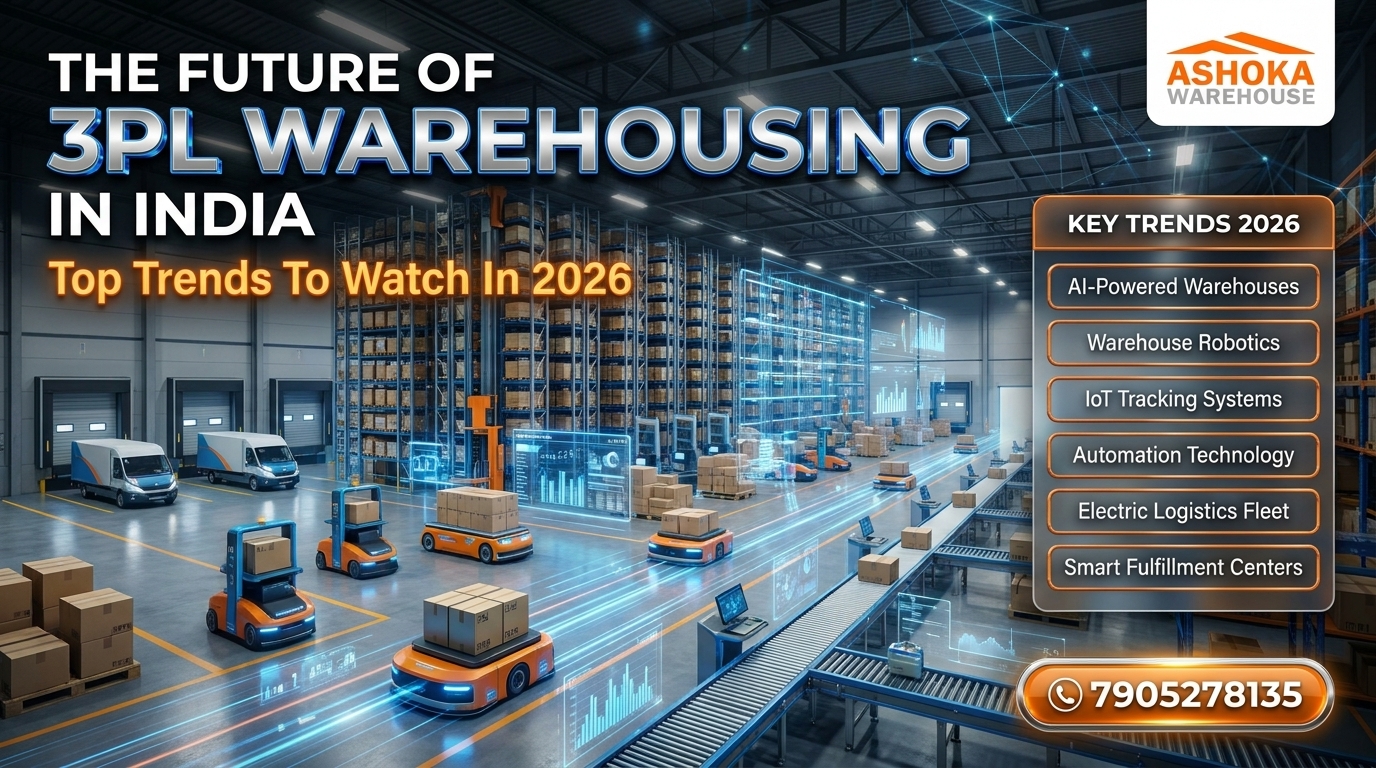
Third-party logistics in India has been in the middle of a structural transformation for the past four years. What started as a response to e-commerce growth has broadened into a wholesale rethinking of how Indian businesses organise their supply chains. In 2026, the trends that were emerging in 2022 and 2023 are now mature enough to evaluate clearly — and the picture they paint for businesses looking at warehousing decisions is more concrete than at any point in recent memory.
For business owners in Lucknow — whether you are running a regional distribution operation, a fast-growing e-commerce brand, or a mid-size manufacturer managing finished goods — understanding where 3PL is headed matters directly to your warehousing strategy. It shapes whether you outsource or go in-house, which locations you prioritise, and why the availability of a quality godown for rent in Lucknow at the right location is suddenly a more consequential decision than it used to be.
This article covers the six most significant trends in Indian 3PL warehousing for 2026, with specific context for the Lucknow market and the Sitapur Road NH-24 corridor near Bakshi Ka Talab.
Trend 1 — Technology Is No Longer Optional in 3PL
The first and most consistent shift in Indian 3PL warehousing is the mandatory nature of technology integration. WMS (warehouse management systems), RFID tracking, barcode scanning, and real-time inventory visibility were differentiators for premium 3PLs two years ago. In 2026, they are baseline expectations from any business above mid-scale.
What this means practically: 3PLs without technology are losing clients to those that offer real-time dashboard access, order tracking, and automated inventory reporting. For businesses evaluating whether to use a 3PL or operate their own 22000 sq.ft warehouse in Lucknow, the technology question is increasingly a wash — modern WMS software accessible at Rs. 20,000 to 35,000 per month brings the same core functionality to an in-house operation that a 3PL would provide.
The implication for location: technology works better in buildings designed to support it. A 22000 sq.ft warehouse on Sitapur Road near Bakshi Ka Talab, built to modern specifications with three-phase power, ceiling heights above 22 feet, and clear column spacing, supports racking and scanning infrastructure that older godown stock simply cannot accommodate efficiently.
Trend 2 — Tier-2 City Expansion Is Reshaping Where 3PLs Invest
For most of the 2010s, Indian 3PL investment was concentrated in tier-1 logistics hubs — Mumbai, Delhi, Bengaluru, Pune, Ahmedabad. Tier-2 cities got service through spoke-level facilities and sub-contracted operators. That model is changing rapidly.
E-commerce growth in non-metro India has been running at 22 to 28 percent annually. Cities like Lucknow, Jaipur, Indore, and Coimbatore now represent meaningful consumer markets with same-day and next-day delivery expectations that cannot be served from a hub 400 km away. 3PLs are establishing or expanding their own facilities in these cities, and independent operators are meeting demand for godown for rent in Lucknow with purpose-built highway-corridor supply.
Lucknow’s position as UP’s state capital and its highway connectivity — NH-24 to Delhi, NH-27 to Kanpur, the Purvanchal Expressway to eastern UP — makes it a natural tier-2 logistics hub for the region. The 22000 sqft godown for rent in Lucknow category is one of the most active segments in the city’s warehousing market, reflecting demand from both independent operators and 3PLs expanding their Lucknow footprint.
Trend 3 — The Rise of Multi-Client Facilities and Shared Infrastructure
One of the most visible structural changes in Indian 3PL warehousing is the growth of multi-client facilities — large warehouses where a 3PL operator serves multiple clients from a single, shared infrastructure. This model offers clients flexibility and shared cost, while allowing the 3PL to achieve occupancy rates and operational economies that single-client facilities cannot match.
For businesses evaluating 3PL versus in-house in Lucknow, the multi-client facility trend has a practical implication: a well-run 3PL in a 40,000 to 60,000 sq.ft facility on the Sitapur Road corridor can offer competitive pricing that a business running its own 22000 sq.ft warehouse in Lucknow would struggle to match on a pure per-unit-cost basis at lower utilisation levels.
The counter-argument — and it is a valid one — is operational control. In a multi-client facility, your goods share a floor with other companies’ inventory. Packing standards, dispatch priorities, and staff focus are managed by the 3PL for all clients simultaneously. For businesses with specific product handling requirements or quality-critical dispatch standards, a dedicated 22000 sq.ft commercial storage facility in Lucknow on a direct lease remains the more operationally dependable choice.
Trend 4 — Specialisation Within 3PL Is Accelerating
The era of the general-purpose 3PL is not over, but the fastest-growing segment of the Indian 3PL market is specialised provision. Cold chain logistics for pharma and food. Fashion and apparel fulfilment with specific hanging and folding requirements. Automotive parts management with strict traceability protocols. E-commerce returns management as a standalone service.
For Lucknow-based businesses in pharmaceuticals, FMCG, or agricultural distribution, this specialisation trend means that the most relevant 3PL comparison is not with a general provider but with one that handles your specific product category. A pharma distributor evaluating a 22000 sq.ft godown for lease in Lucknow against a pharma-specialist 3PL is comparing two genuinely different propositions — and the specialist 3PL may offer regulatory compliance support, temperature-controlled infrastructure, and batch documentation management that a self-managed facility would need to replicate entirely from scratch.
On the other hand, if your product category is not one where specialist 3PL adds specific value, the general 3PL premium is harder to justify when a 22000 sq.ft warehouse for rent in Lucknow on the Sitapur Road NH-24 corridor can provide equivalent operational infrastructure at lower total cost.
Trend 5 — Sustainability and Green Warehousing Are Entering Indian Supply Chains
This trend is further advanced in international markets but is beginning to appear in India’s major logistics contracts. Large FMCG companies, export-oriented manufacturers, and businesses supplying international retail chains are increasingly including sustainability criteria in their logistics partner evaluations. Energy efficiency, solar power readiness, LED lighting, and responsible water use are moving from aspirational to contractual in some segments of the market.
For operators looking at a 22000 sq.ft warehouse for rent per sq.ft on the Sitapur Road corridor in Lucknow, new construction properties are better positioned to add solar panels, LED infrastructure, and rainwater harvesting than older godown stock. The 22000 sq.ft warehouse in Lucknow category on this corridor, being predominantly new construction, has a lower retrofit cost for sustainability compliance than alternatives in established zones with older buildings.
Trend 6 — The Hybrid Model Is Becoming Standard Practice
Perhaps the most practically significant trend for business owners in Lucknow is the normalisation of hybrid warehousing — a model where businesses maintain an in-house primary facility for core, high-frequency operations and use 3PL overflow capacity for seasonal peaks.
This model has been used by large enterprises for years. In 2026, it is becoming accessible to mid-size businesses too, as 3PLs in cities like Lucknow have developed more flexible short-term capacity arrangements. For a business operating from a 22000 sq.ft godown for rent in Lucknow as its primary facility at 70 to 80 percent utilisation year-round, using a 3PL for 4 to 8 weeks of peak overflow is significantly cheaper than sizing the primary facility for peak — and more reliable than trying to find ad-hoc overflow space in the middle of a busy season.
The Bakshi Ka Talab NH-24 corridor is particularly well-positioned for this model. The 22000 sq.ft warehouse on Sitapur Road provides the in-house core, while the growing cluster of 3PL facilities and managed warehouses on the same corridor provides accessible overflow capacity without the logistics of managing supply from a distant location.
What These Trends Mean for Lucknow Business Owners
Taken together, these six trends point toward a warehousing landscape in Lucknow that is more structured, more technology-dependent, and more location-sensitive than it was even three years ago. The businesses that navigate this landscape well are those that make their warehousing decisions based on operational logic and clear-eyed cost analysis — not inertia or convenience.
For businesses currently using 3PL that are growing toward a consistent 22,000 sq.ft-equivalent capacity, the trend toward in-house at scale is financially supported by the current market. A 22000 sq.ft warehouse for rent in Lucknow on the Sitapur Road corridor near Bakshi Ka Talab at Rs. 18 to 24 per sq.ft provides the platform for a cost-competitive in-house operation that the trends above make increasingly viable.
For businesses currently in-house at a smaller scale, the 3PL flexibility trend means the overflow option is improving — making a hybrid approach more accessible than before. And for businesses evaluating 3PL specifically, the specialisation trend means the right question is not just ‘which 3PL is cheapest’ but ‘which 3PL has specific expertise in my product category at the Lucknow scale.’
Frequently Asked Questions (FAQ)
At what business size does in-house warehousing in Lucknow become cheaper than 3PL?
The crossover point for most business types in Lucknow is when you can consistently utilise above 75 percent of a warehouse at the lowest cost tier. For a 22,000 sq.ft warehouse on the Sitapur Road NH-24 corridor at Rs. 18 to 22 per sq.ft, this typically corresponds to monthly throughput of Rs. 40 to 80 lakh. Below this, 3PL flexibility often outweighs the in-house cost advantage. Above it, in-house economics are materially better.
Why does the Bakshi Ka Talab NH-24 location specifically improve in-house logistics economics?
Three reasons: lower rent for equivalent specification versus established zones (saving Rs. 1.5 to 3.5 lakh monthly on a 22,000 sq.ft facility), highway access eliminating city-traffic cost from vehicle movements, and modern construction enabling efficient warehouse layout that improves per-unit handling cost. The combination shifts the in-house vs 3PL cost comparison by Rs. 3 to 6 lakh per month in favour of in-house for a well-run operation.
What documentation should I verify before signing a lease for a 22,000 sq.ft warehouse in Lucknow?
Fire NOC (current, issued for the building as standing), building completion or occupancy certificate, land use classification confirming industrial or warehouse activity, registered lease agreement, and property tax receipts. For a 22000 sq.ft warehouse for rent in Lucknow, also verify the floor load rating and power connected load against your operational requirements before signing.
The in-house vs 3PL decision in 2026 is not a philosophical debate — it is a financial calculation that depends on your volumes, your seasonal profile, your product type, and critically, the quality and cost of warehouse space you can access. For businesses in Lucknow with access to a 22000 sq.ft godown for rent in Lucknow on the Sitapur Road NH-24 corridor at Rs. 18 to 24 per sq.ft, the in-house model is more economically compelling than it has been in years.